Viking kitchen appliances · range
Professional range repair
Sealed burners, the spark system, the oven cavity and the door. A range is four separate systems in one cabinet, and each one fails in its own way.
- Burner clicks but never lights
- Igniter keeps clicking after the burner has lit
- Burner lights, then goes out when the knob is released
- One burner runs low while the others are fine
- Oven never reaches the set temperature
- Oven overshoots, then swings twenty degrees either side
- Oven will not ignite at all, cooktop is fine
- Door will not close square, or drops when opened
- Smell of gas at the back of the cabinet
A professional range is four systems sharing one cabinet: the sealed surface burners, the spark and ignition circuit, the oven cavity with its own igniter and sensor, and the door. Each fails on its own schedule. The survey works through them in that order, because a fault in one can look exactly like a fault in another.
Surface burners
A burner that clicks but never lights is almost always gas delivery, not spark — you can hear the spark. Check the cap seating first: a cap set down a millimetre off its ring after a cleaning will spread the flame sideways instead of up through the ports, and the burner will refuse to catch. Then the ports themselves. A boil-over that dried in place blocks enough of the ring that the flame cannot travel around it.
A burner that lights and then dies the moment you release the knob is a different fault entirely. That is the flame-sensing thermocouple failing to tell the safety valve that a flame exists. It is a small part and a straightforward replacement, and it has nothing to do with the spark module.
A burner that clicks continuously — all of them clicking, not one — usually means moisture in the spark module or a switch that has not fully released. Spills that run down behind a knob get into that circuit and keep it firing.
The oven cavity
An oven that never reaches setpoint, or swings wide either side of it, is a sensing problem before it is a heating problem. The oven temperature sensor is a resistance device: it changes resistance with heat, and the control reads that resistance to decide when to fire. A sensor that has drifted still reads something, which is why the oven still works — badly. Measuring it cold and comparing against spec takes two minutes and settles the question.
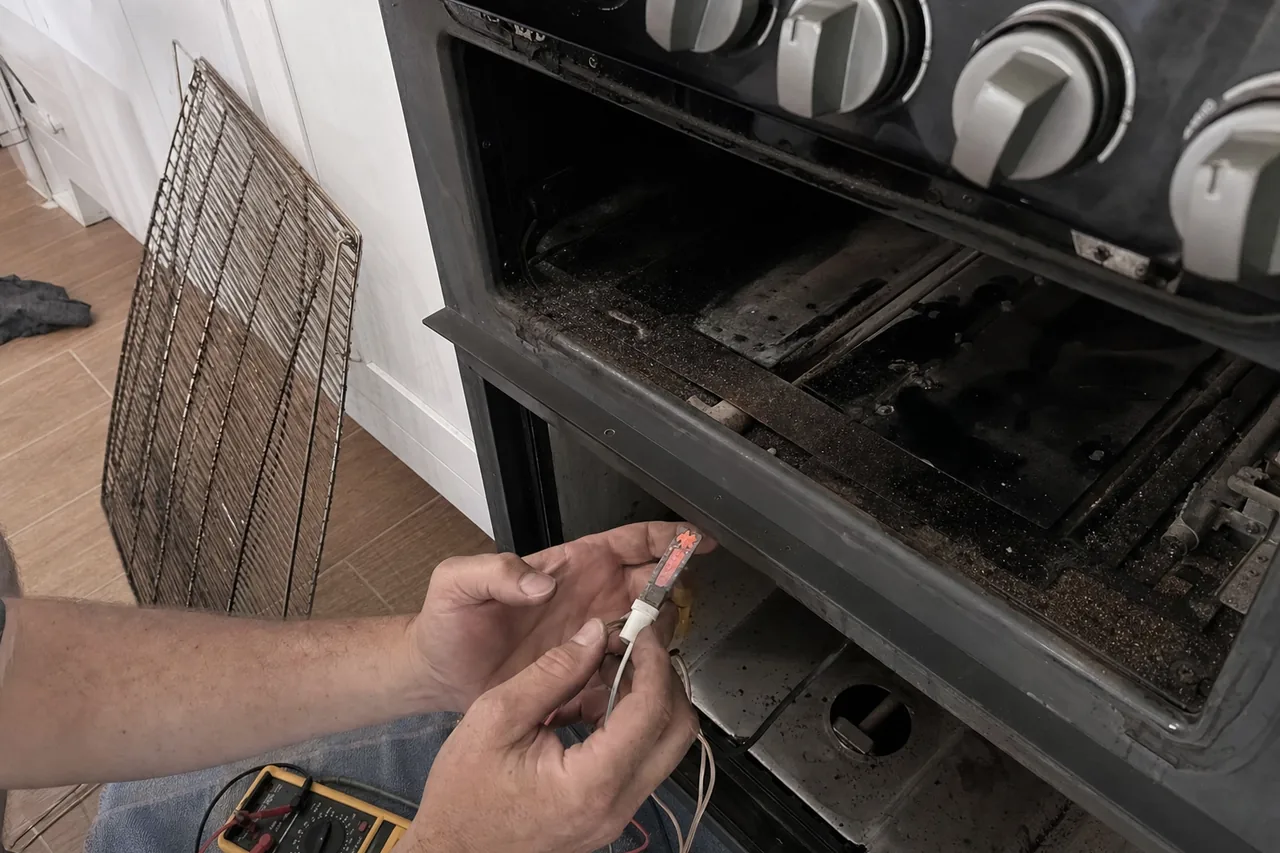
An oven that will not ignite at all while the cooktop works normally points at the oven igniter. On a gas oven the igniter is also the safety: it has to draw enough current to open the gas valve. An igniter that glows bright orange and still will not light the oven is the classic case — it looks healthy and is not, because it has aged past its current draw. This is why an amp reading matters and a visual check does not.
Which fuel it was set for
Before any of the above is acted on, one question settles a surprising number of cooktop complaints: which gas the range was set for. A range built for natural gas and converted to LP needs different orifices, and in most cases a different regulator setting and a different low-flame adjustment on every valve. Both fuels are in ordinary use around this part of Clay County.
A conversion that was done partly, or done years ago and never marked, produces flames that lift off the ports, flames that burn yellow at the tips, or a simmer setting that cannot hold. Those look like burner faults. They are settings. The rating plate normally records which fuel the appliance left the assembly line set for, so photograph it before you call.
The door
Heavy doors wear their hinges and springs. A door that will not close square, or that drops rather than swings, has usually gone past what adjustment can recover. That matters beyond the annoyance: a door that does not seal lets the cavity bleed heat, and the control compensates by firing longer, which reads to the owner as an oven that runs hot and cannot hold a temperature. Chasing the sensor on that fault wastes a part.
Gas smell
Stop. Shut the supply off at the valve and call the gas utility before you call us. We will happily take the repair afterwards, but a gas smell is their call first, not ours.
What does professional range repair cost?
The visit is a flat $80, credited toward the repair when you approve the work. What the repair runs on professional range repair is below, parts and labour together, before the written estimate narrows it to one figure.
| Work | Parts and labour |
|---|---|
| Diagnostic visit | $80 flat, credited |
| Igniter or burner assembly | $210–$520 |
| Control board or touch panel | $380–$940 |
| Oven thermostat or heating element | $190–$610 |
It is a band and not a price because one symptom is usually several repairs, and they do not cost the same. The survey is what picks which one it is. The whole book, and what the fee buys.
Asked before a range call
- What does professional range repair cost in Clay County?
- The visit is a flat $80, credited toward the repair when you approve the work. Control board or touch panel work runs $380–$940, parts and labour together. An itemised estimate reaches you before a part is ordered, and turning it down costs the diagnostic and nothing beyond it.
- How long is professional range repair guaranteed?
- 90 days on the labour, 365 days on parts we supply. Genuine OEM parts only. We do not fit aftermarket substitutes into a professional range. An aftermarket igniter or sensor is the commonest reason a professional appliance comes back a second time, so none of them ride on the van.
- What should I have ready when I call?
- The model and serial off the rating plate, the symptom in the words you would use, and what changed just before it started. Parts on this equipment are revised mid-production, so the serial decides which one is correct more often than the model does.
Places on the peninsula where this equipment fails in a way worth writing down separately.
- Fleming Island: what actually fails hereA peninsula of kitchens that got their professional equipment when the houses were built. What ends its service life is ignition, sensing, control and wear.
- Eagle Harbor: island rangetops, remote blowersA golf community whose kitchens mostly went in with the houses. That single fact decides which parts we carry to an Eagle Harbor address.
- Pace Island: generators and control boardsA gated riverfront community. Two things shape the work here: getting through the gate, and what a whole-house generator does to control electronics.
- Hibernia Plantation: retrofit kitchensThe oldest-settled corner of the island. Older houses mean retrofit kitchens, and a retrofit kitchen fails at the install before it fails at the appliance.
Surveys that work through one of these faults step by step.
- When a Viking oven drifts off setpointFour checks in order, cheapest and most likely first. Most ovens that will not hold temperature are not asking for a control board.
- When the igniter glows but nothing lightsThe most convincing-looking part in a gas oven is often the failed one. Brightness proves nothing; only the current it draws opens the gas valve.
- Heavy doors, hinges and springsA door is a heat seal that happens to swing. When it stops closing square, the oven starts behaving like a sensor fault — and replacing the sensor changes nothing.
- Cabinetry around Viking appliancesPlan the cabinets around the Viking numbers, not the other way round: range clearances, hood width and height, fridge openings, door swing and the utilities behind them.
- Storm season and control boardsBoards do fail here, and they mostly fail on a date rather than from age. That is a useful thing to know, because it changes the order of the whole survey.
- Continuous clicking after a spillContinuous spark on every burner is upstream of any single burner. Dry it out properly before anyone buys a spark module, because most of these dry out.
- Reading the rating plateTwo numbers off a metal tag decide whether the part is on the van or on order. Here is where the tag is on each kind of appliance, and what else to read off it.
What owners said after this work
4.5 out of 5, across 70 published owner notes. Read all of them.
The oven held its number but every top burner had gone lazy. He checked supply pressure at the manifold before touching a burner, found it low, and had the honest conversation with me about whose job that one is.
Isolde M.
The center burner lit and then dropped straight back out as soon as I let the knob go. He traced it to a thermocouple gone lazy rather than the valve behind it, fitted a new one and checked the other burners before packing up.
Marisol V.
Two burners kept clicking long after they lit. Instead of selling me a module he pulled the knobs and showed me dried syrup across the switch bank. Cleaned and dried first, then one switch changed because that one had truly failed.
Harriet O.
Fleming Island, Clay County. Have the model number off the rating plate ready — it decides which parts ride out on the van. What a visit costs.