Fault survey · Viking kitchen appliances
When the igniter glows but nothing lights
The most convincing-looking part in a gas oven is often the failed one. Brightness proves nothing; only the current it draws opens the gas valve.
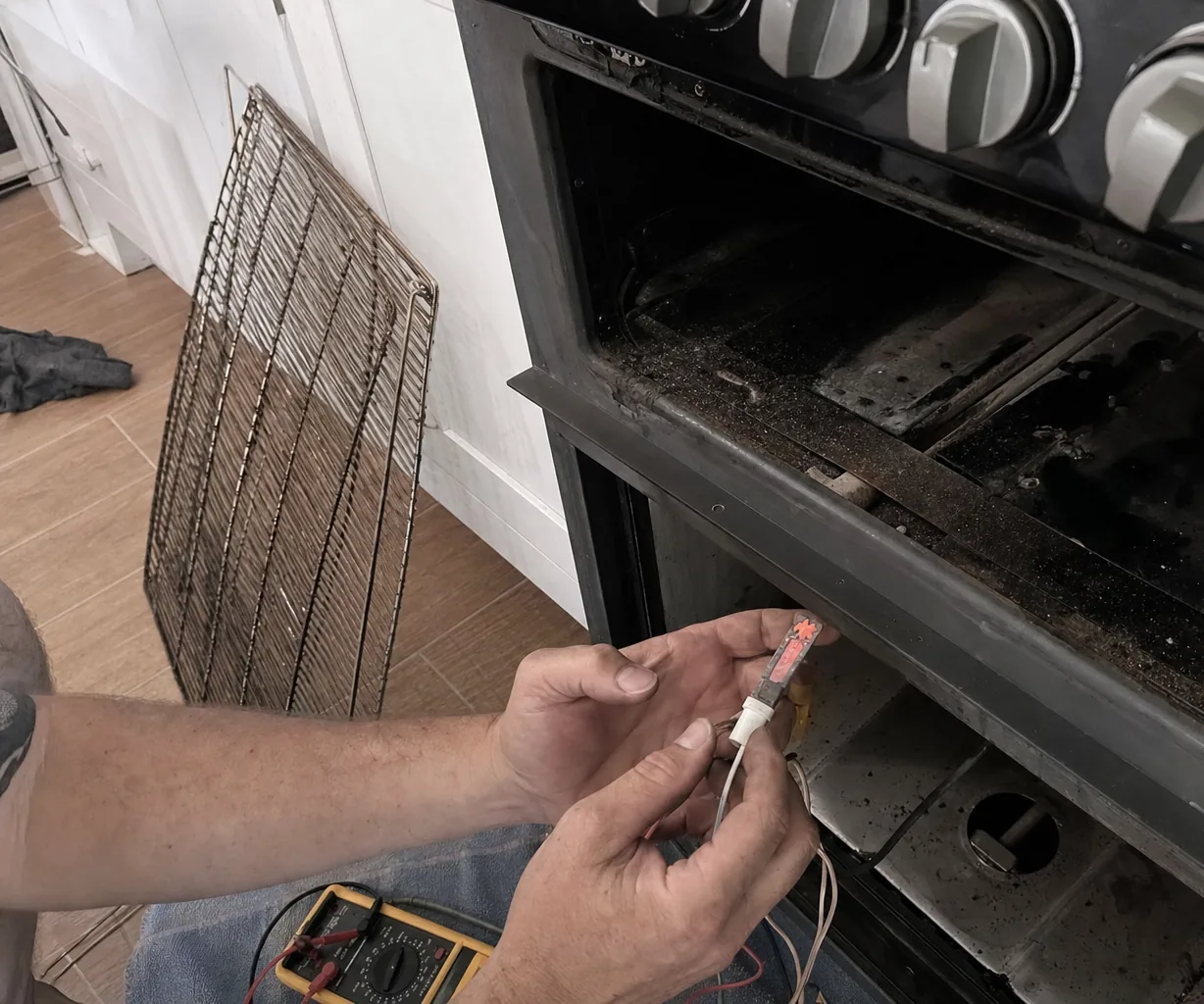
This is the fault people argue with us about, and they are right to, because the evidence in front of them appears conclusive. The oven will not light. They open the door, look at the igniter, and see it glowing bright orange. The obvious conclusion is that the igniter is working and something else is wrong.
It is the wrong conclusion, and the reason is worth understanding because it changes how you interpret every symptom that follows.
The igniter is the safety device
On a gas oven, the igniter does two jobs. It lights the gas, and it is also the interlock that decides whether gas is allowed out at all.
The safety valve in the gas line is opened by current. The igniter is wired in series with it, and as the igniter heats, its resistance falls and the current through the circuit rises. When that current reaches the threshold the valve needs, the valve opens, gas arrives, and the igniter — by then extremely hot — lights it. If the current never reaches the threshold, the valve never opens.
That design is deliberate and it is good: gas cannot be released unless something hot enough to light it is already proven to be there.
Why a healthy-looking igniter fails
The consequence of that design is the whole of this article. An igniter ages. Over years of thermal cycling its resistance rises, and rising resistance means falling current. It gets dimmer only slightly. It goes on glowing a convincing orange long after the current it draws has fallen below what the valve requires.
So there is a window — often a long one — where the igniter looks perfect and is functionally dead. During that window the appliance behaves in exactly these ways:
- The oven lights sometimes and not other times.
- It takes much longer to light than it used to, and the owner notices only in retrospect.
- It lights when the oven is cold but not on a second bake when everything is already hot.
- It lights, runs, and then fails to relight when the burner cycles during a long bake, so the oven quietly loses temperature partway through.
Every one of those is normally reported as a thermostat problem, a sensor problem or a board problem. None of them is.
How it is actually tested
With a clamp meter around one leg of the igniter circuit, energised, reading the current it actually draws while it glows. Compare that reading against the specification for the igniter in that appliance. In range or out of range — the question is closed either way in a couple of minutes.
There is a second observation worth making at the same time: how long the igniter glows before gas arrives. A long delay with no ignition at the end of it is the same story told a different way.
Note what is not a test. Colour is not a test. Brightness is not a test. Continuity is not a test either — an igniter with a rising resistance still shows continuity, which is why a meter set to ohms produces a confident and useless result.
What follows from a bad reading
Replacement, and one piece of handling advice: these elements are brittle and their useful life is shortened by being touched. Handle a new one by its bracket and its leads.
If the reading is in range, the igniter has been ruled out with a number rather than a glance, and the survey moves on to the gas supply and the safety valve itself before anything electronic is considered.
Why this one gets its own entry
Because the igniter is a consumable and the board is not. On the equipment we see around Fleming Island, an igniter reaching the end of its life is one of the two or three most common reasons a professional range or wall oven stops working, and it is routinely misdiagnosed as something four or five times the price. Checking it takes a few minutes and it comes early in the survey for exactly that reason.
What does this one cost to put right?
The visit is a flat $80, credited toward the repair when you approve the work. What the repair runs on when the igniter glows but nothing lights is below, parts and labour together, before the written estimate narrows it to one figure.
| Work | Parts and labour |
|---|---|
| Diagnostic visit | $80 flat, credited |
| Igniter or burner assembly | $210–$520 |
| Oven thermostat or heating element | $190–$610 |
It is a band and not a price because one symptom is usually several repairs, and they do not cost the same. The survey is what picks which one it is. The whole book, and what the fee buys.
Asked after reading this
- What does this repair cost?
- Oven thermostat or heating element work runs $190–$610, parts and labour together, on top of the flat $80 diagnostic that is credited toward the repair when you approve the work. The survey is what turns a band into the one figure written on your estimate.
- Is when the igniter glows but nothing lights worth repairing at that figure?
- Set it against $4,800–$17,500 for a comparable Viking appliance, before delivery, installation or cabinetry. Professional equipment is built to be repaired, so the answer is usually yes — and where it is not, we tell you before ordering anything.
- Do you work on any make other than Viking?
- No. One manufacturer is what puts the correct igniter, spark module and oven sensor on the van before the first visit rather than after it. A shop claiming every brand is carrying the parts for none of them.
The service pages this survey belongs to.
- Professional range repairSealed burners, the spark system, the oven cavity and the door. A range is four separate systems in one cabinet, and each one fails in its own way.
- Built-in wall oven repairA wall oven is a sealed box inside a cabinet. The part is rarely the hard part — getting the machine out of the wall and back in square is.
- Rangetop and cooktop repairA rangetop has no oven to hide behind. Ignition, gas delivery and flame quality account for very nearly every call we take on one.
Places where this fault shows up often enough to be worth the note.
- Fleming Island: what actually fails hereA peninsula of kitchens that got their professional equipment when the houses were built. What ends its service life is ignition, sensing, control and wear.
- Eagle Harbor: island rangetops, remote blowersA golf community whose kitchens mostly went in with the houses. That single fact decides which parts we carry to an Eagle Harbor address.
Reading a survey and recognising your own appliance in it is a good reason to call. What a visit costs.