Fault survey · Viking kitchen appliances
When a Viking oven drifts off setpoint
Four checks in order, cheapest and most likely first. Most ovens that will not hold temperature are not asking for a control board.
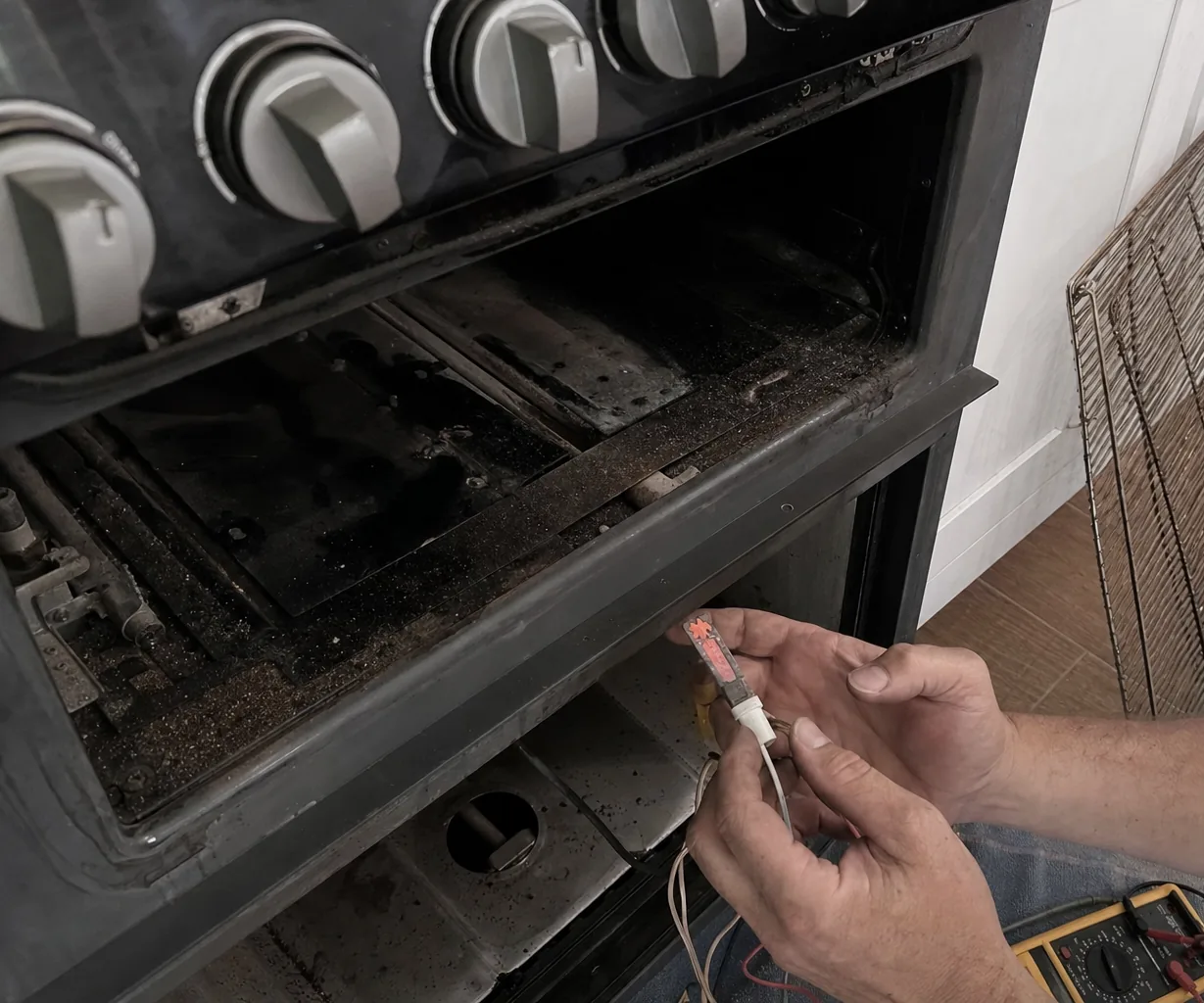
“It runs cold” and “it runs hot” are the same complaint. Both mean the oven and the control no longer agree about what the cavity temperature is. There are four places that disagreement can come from, and they are worth checking in this order — cheapest and most likely first.
1. The door and the gasket
Before anything electrical: close the door and look at the gap along the top edge, then along the hinge side. A cavity that bleeds heat forces the control to fire longer and more often to hold setpoint, and the owner experiences that as an oven that will not settle.
Then check the gasket itself. A gasket that has hardened, flattened along the bottom run or pulled out of a corner clip does the same thing. Both of these are visible in ten seconds and neither requires a meter.
If the door will not close square at all, stop here. That is a hinge and spring job, and no amount of sensor work will fix it.
2. The oven temperature sensor
The sensor is a resistance device. It changes resistance as it heats, and the control reads that resistance to decide when to fire. The important property is that a failed sensor rarely fails to nothing — it drifts. It keeps reporting a plausible number that is simply wrong, which is exactly why the oven still works and works badly.
Measure it cold at room temperature and compare against the specification for that sensor. If it is out of range cold, it is worse hot. This is a short check and it settles the question either way, which is why it comes before anything involving a board.
3. Igniter current, on a gas oven
On a gas oven the igniter is also the safety interlock. It has to draw enough current for long enough to open the gas valve. As it ages its resistance rises and its current draw falls, and there is a window where it still glows bright orange — looks perfect — but no longer pulls enough to hold the valve open reliably.
That produces an oven that lights sometimes, or lights and then goes out on a long bake, or takes several minutes longer than it used to. The visual check tells you nothing here. The amp reading tells you everything.
4. The control board
Last, not first. Boards do fail, and around here they mostly fail after a storm-season power event rather than from age alone — this region gets roughly 68 thunderstorm days a year and the equipment has usually sat through a decade of them.
But a board is the most expensive part in the sequence, and it is the one most often replaced by people who never checked the three cheaper things above it. If the door seals, the sensor reads in spec cold, and the igniter pulls its rated current, then the board has earned its turn as the suspect. Not before.
What the owner can check first
Two of these four are visible without a meter, and it is worth doing them before the appointment because they change what we bring.
Close the door on a strip of paper and pull it out at several points around the seal, top, bottom and both sides. Where it slides out freely the door is not sealing there. Then run a hand along the gasket: it should be resilient rather than stiff, and it should sit evenly in its channel the whole way round.
Then use an oven thermometer, sitting on the centre rack, and let a preheated oven settle for at least twenty minutes before reading it. A single reading taken the moment the preheat tone sounds is not evidence of anything — the cavity walls are still catching up with the air. What matters is the settled figure and how far it wanders over the next half hour.
The point of the order
Every step above rules something out with a measurement, not a guess. That is what makes it a survey rather than a parts swap — and it is why the diagnostic fee is flat rather than open-ended. The sequence takes the time it takes, and it is the same sequence every time.
What does this one cost to put right?
The visit is a flat $80, credited toward the repair when you approve the work. What the repair runs on when a viking oven drifts off setpoint is below, parts and labour together, before the written estimate narrows it to one figure.
| Work | Parts and labour |
|---|---|
| Diagnostic visit | $80 flat, credited |
| Oven thermostat or heating element | $190–$610 |
| Control board or touch panel | $380–$940 |
It is a band and not a price because one symptom is usually several repairs, and they do not cost the same. The survey is what picks which one it is. The whole book, and what the fee buys.
Asked after reading this
- What does this repair cost?
- Control board or touch panel work runs $380–$940, parts and labour together, on top of the flat $80 diagnostic that is credited toward the repair when you approve the work. The survey is what turns a band into the one figure written on your estimate.
- Is when a viking oven drifts off setpoint worth repairing at that figure?
- Set it against $4,800–$17,500 for a comparable Viking appliance, before delivery, installation or cabinetry. Professional equipment is built to be repaired, so the answer is usually yes — and where it is not, we tell you before ordering anything.
- Do you work on any make other than Viking?
- No. One manufacturer is what puts the correct igniter, spark module and oven sensor on the van before the first visit rather than after it. A shop claiming every brand is carrying the parts for none of them.
The service pages this survey belongs to.
- Professional range repairSealed burners, the spark system, the oven cavity and the door. A range is four separate systems in one cabinet, and each one fails in its own way.
- Built-in wall oven repairA wall oven is a sealed box inside a cabinet. The part is rarely the hard part — getting the machine out of the wall and back in square is.
Places where this fault shows up often enough to be worth the note.
- Fleming Island: what actually fails hereA peninsula of kitchens that got their professional equipment when the houses were built. What ends its service life is ignition, sensing, control and wear.
- Eagle Harbor: island rangetops, remote blowersA golf community whose kitchens mostly went in with the houses. That single fact decides which parts we carry to an Eagle Harbor address.
Reading a survey and recognising your own appliance in it is a good reason to call. What a visit costs.