Fault survey · Viking kitchen appliances
Continuous clicking after a spill
Continuous spark on every burner is upstream of any single burner. Dry it out properly before anyone buys a spark module, because most of these dry out.
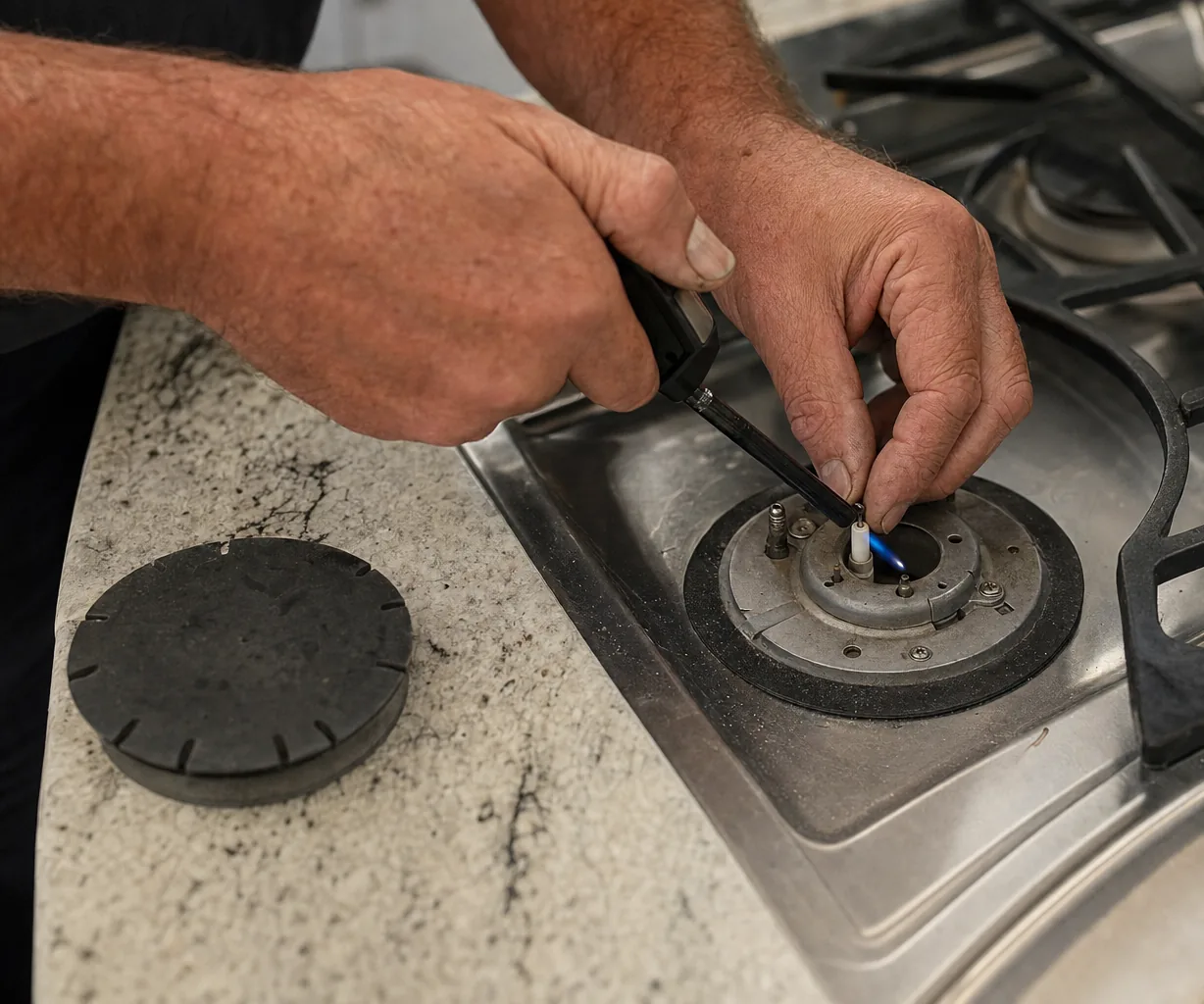
A cooktop that ticks continuously — every burner sparking together, sometimes with all the knobs in the off position — is one of the few faults that announces its own location. A single burner cannot cause it. Whatever is wrong sits upstream of all of them, in the circuit that tells the spark module to fire.
There are three candidates, and they should be worked in this order because the first one costs nothing and accounts for most cases.
1. Liquid in a switch
Almost every one of these calls follows something: a boil-over, a pan of water that went over the side, an enthusiastic wipe-down with a wet cloth, or a cleaning where liquid ran down the fascia. Behind each knob is a switch that closes when the knob is turned to the spark position. Liquid that reaches that switch bridges it, the module reads a permanent request for spark, and it fires continuously.
The module is doing exactly what it was told. Replacing it will not help while the instruction is still wrong.
The correct first response is to cut power to the appliance at the breaker — not just switch it off — and let it dry. Properly dry, which in a Florida kitchen in August means longer than you think and is helped considerably by running the room air conditioning rather than opening a window onto ninety per cent humidity. Twenty-four hours is a reasonable trial. A great many of these calls resolve themselves at this step, and we would rather tell you that on the phone than charge you to watch it happen.
If it dries out and returns the next time something boils over, the switch itself has been damaged and needs replacing. That is a part, but a small one, and it is still not the module.
2. A cracked electrode
If nothing was spilled, look at the electrodes. Each burner has one: a thin metal pin inside a white ceramic insulator, positioned to jump its spark across a defined gap to the burner base.
Ceramic cracks. A pot dragged across the surface, a burner cap dropped during cleaning, or years of thermal cycling will do it. Once the insulator is cracked, the spark takes the shortest available path — which may be through the crack to the nearest metal rather than across the intended gap. That can present as one burner that will not light, as sparking that continues where it should not, or as an audible tick coming from a burner nobody has switched on.
Look for a scorch mark or a dark track on the ceramic. It is frequently visible without any tools once you know to look.
3. The module itself
Last. Spark modules do fail, and when they do, they fail in this way. But a module is the most expensive item in this survey and it is the one most often replaced by someone who never cut the power and waited.
The order above exists because two of the three causes are free to rule out. If the appliance has been fully dried, every electrode is intact and unscorched, and the clicking persists with all knobs confirmed released, then the module has earned the diagnosis.
Is it safe to keep using?
Practical guidance rather than alarm. A continuously sparking cooktop is irritating and it is drawing an ignition circuit permanently, but the safety valves are unaffected — gas is not being released by spark alone. What it is doing is wearing electrodes and running a circuit that was never meant to run continuously.
If you can smell gas, that is a different situation entirely and it is not a repair question. Shut the supply off at the valve and call the gas utility first. We will take the repair afterwards.
What does this one cost to put right?
The visit is a flat $80, credited toward the repair when you approve the work. What the repair runs on continuous clicking after a spill is below, parts and labour together, before the written estimate narrows it to one figure.
| Work | Parts and labour |
|---|---|
| Diagnostic visit | $80 flat, credited |
| Igniter or burner assembly | $210–$520 |
It is a band and not a price because one symptom is usually several repairs, and they do not cost the same. The survey is what picks which one it is. The whole book, and what the fee buys.
Asked after reading this
- What does this repair cost?
- Igniter or burner assembly work runs $210–$520, parts and labour together, on top of the flat $80 diagnostic that is credited toward the repair when you approve the work. The survey is what turns a band into the one figure written on your estimate.
- Is continuous clicking after a spill worth repairing at that figure?
- Set it against $4,800–$17,500 for a comparable Viking appliance, before delivery, installation or cabinetry. Professional equipment is built to be repaired, so the answer is usually yes — and where it is not, we tell you before ordering anything.
- Do you work on any make other than Viking?
- No. One manufacturer is what puts the correct igniter, spark module and oven sensor on the van before the first visit rather than after it. A shop claiming every brand is carrying the parts for none of them.
The service pages this survey belongs to.
- Rangetop and cooktop repairA rangetop has no oven to hide behind. Ignition, gas delivery and flame quality account for very nearly every call we take on one.
- Professional range repairSealed burners, the spark system, the oven cavity and the door. A range is four separate systems in one cabinet, and each one fails in its own way.
Places where this fault shows up often enough to be worth the note.
- Fleming Island: what actually fails hereA peninsula of kitchens that got their professional equipment when the houses were built. What ends its service life is ignition, sensing, control and wear.
Reading a survey and recognising your own appliance in it is a good reason to call. What a visit costs.