Conditions · Viking kitchen appliances
Storm season and control boards
Boards do fail here, and they mostly fail on a date rather than from age. That is a useful thing to know, because it changes the order of the whole survey.
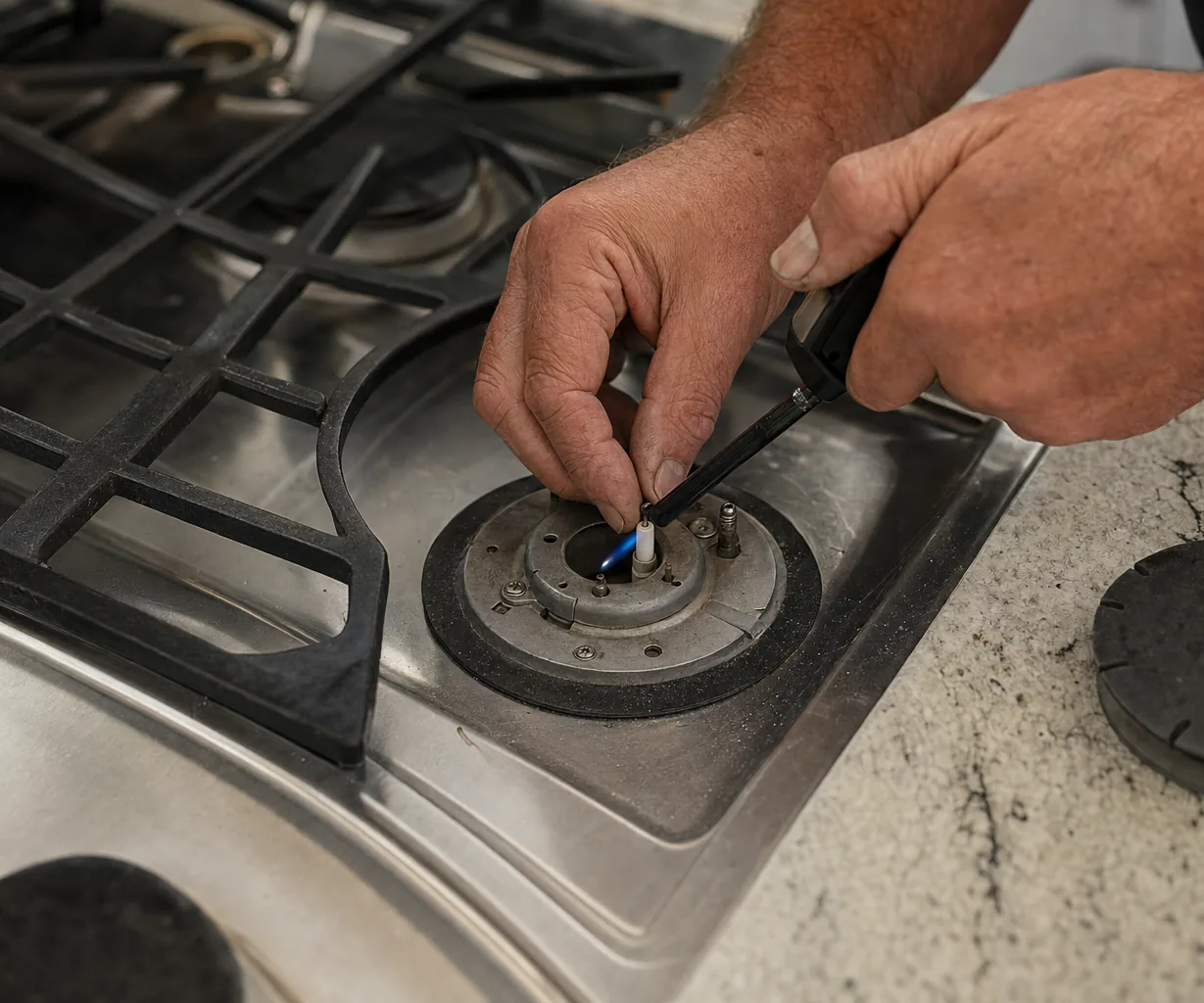
Every survey on this site puts the control board last. This entry explains the one local condition that occasionally justifies moving it up, and why even then the cheaper checks come first.
The condition
This region sees roughly 68 thunderstorm days a year. That figure is worth sitting with. It means that on something like one day in five, on average across the year, there is convective weather over Clay County — and in the summer months the real rate is far higher than the annual average implies, because those days are not distributed evenly. Hurricane season adds multi-day outages on top of that.
Appliances do not care about rain. They care about what happens to the supply. Direct strikes are rare and dramatic; what is common is everything around them: nearby strikes coupling onto lines, momentary interruptions as protective equipment operates and recloses, voltage sags when a large load drops off, and the sequence of interruptions that follows when power is restored.
A control board is a small computer with a power supply. It is the component in any appliance least tolerant of that treatment, and unlike a motor or a valve, it gives no warning. It works, and then on a specific day it does not.
Standby generators do it twice
Waterfront houses in Clay County carry standby generators at a higher rate than inland houses, for obvious and sensible reasons. It is worth knowing that a generator does not smooth this out for the appliance.
When utility power drops, the transfer switch waits, the engine starts, and load transfers. When utility power returns, the load transfers back. From the point of view of a wall oven, one outage becomes two interruptions rather than none. A house with a generator gets its food kept cold and its lights on, which is the whole point, but its appliance electronics are not seeing fewer events than the neighbours’.
That is not an argument against a generator. It is an argument for talking to an electrician about surge protection at the panel, which is a different trade from ours and the right one to ask.
The date is diagnostic information
Here is the practical consequence. When you call, tell us if the appliance stopped working in a week when the power did something unusual. It is the single most useful piece of context after the model number.
Two follow-up questions matter as much:
Did anything else in the house go at the same time? Two dead boards in one kitchen after one storm is not two coincidences. It is one event, and it changes what we recommend about protecting the rest.
Did it stop all at once, or degrade? Boards mostly fail cleanly. A fault that came on gradually over months is almost certainly not the board — it is a sensor drifting, an igniter ageing, or hardware wearing, all of which are cheaper and all of which sit earlier in the survey.
Why the board still comes last
Even in storm season, the board is the last suspect in the sequence, and the reason is arithmetic rather than principle.
The board is the most expensive part in almost every appliance we open. The faults ahead of it in the survey — a door that no longer seals, a gasket that has gone hard, a temperature sensor that has drifted, an igniter that has aged past its current draw, a condenser blanketed with dust, a spark switch holding closed because something was spilled on it — are cheap to test and cheap to fix, and between them they account for the large majority of what we are called to.
Replacing a board without ruling those out is how a repair costs several times what it needed to and then fails again, because the underlying condition was never the board.
What we do when it is the board
We say so, in writing, before anything is ordered. On older equipment a board can be difficult to source, and that is a conversation worth having honestly rather than optimistically: sometimes the right advice on a twenty-five-year-old appliance is that the burners and the cabinet have decades left in them and the electronics do not, and sometimes it is the reverse. Either way you get the reasoning and the number before a decision, not after.
What does this one cost to put right?
The visit is a flat $80, credited toward the repair when you approve the work. What the repair runs on storm season and control boards is below, parts and labour together, before the written estimate narrows it to one figure.
| Work | Parts and labour |
|---|---|
| Diagnostic visit | $80 flat, credited |
| Control board or touch panel | $380–$940 |
It is a band and not a price because one symptom is usually several repairs, and they do not cost the same. The survey is what picks which one it is. The whole book, and what the fee buys.
Asked after reading this
- What does this repair cost?
- Control board or touch panel work runs $380–$940, parts and labour together, on top of the flat $80 diagnostic that is credited toward the repair when you approve the work. The survey is what turns a band into the one figure written on your estimate.
- Is storm season and control boards worth repairing at that figure?
- Set it against $4,800–$17,500 for a comparable Viking appliance, before delivery, installation or cabinetry. Professional equipment is built to be repaired, so the answer is usually yes — and where it is not, we tell you before ordering anything.
- Do you work on any make other than Viking?
- No. One manufacturer is what puts the correct igniter, spark module and oven sensor on the van before the first visit rather than after it. A shop claiming every brand is carrying the parts for none of them.
The service pages this survey belongs to.
- Professional range repairSealed burners, the spark system, the oven cavity and the door. A range is four separate systems in one cabinet, and each one fails in its own way.
- Built-in wall oven repairA wall oven is a sealed box inside a cabinet. The part is rarely the hard part — getting the machine out of the wall and back in square is.
- Built-in refrigeration repairColumns, French-door built-ins, undercounter drawers and wine storage. Airflow, defrost and door seal explain most of it before the sealed system does.
- Ventilation and hood repairBlower, controls, lights and duct. A hood that fails to clear the air is usually failing at the duct, and no larger blower will fix that.
Places where this fault shows up often enough to be worth the note.
- Fleming Island: what actually fails hereA peninsula of kitchens that got their professional equipment when the houses were built. What ends its service life is ignition, sensing, control and wear.
- Pace Island: generators and control boardsA gated riverfront community. Two things shape the work here: getting through the gate, and what a whole-house generator does to control electronics.
- Hibernia Plantation: retrofit kitchensThe oldest-settled corner of the island. Older houses mean retrofit kitchens, and a retrofit kitchen fails at the install before it fails at the appliance.
Reading a survey and recognising your own appliance in it is a good reason to call. What a visit costs.