Viking kitchen appliances · wall oven
Built-in wall oven repair
A wall oven is a sealed box inside a cabinet. The part is rarely the hard part — getting the machine out of the wall and back in square is.
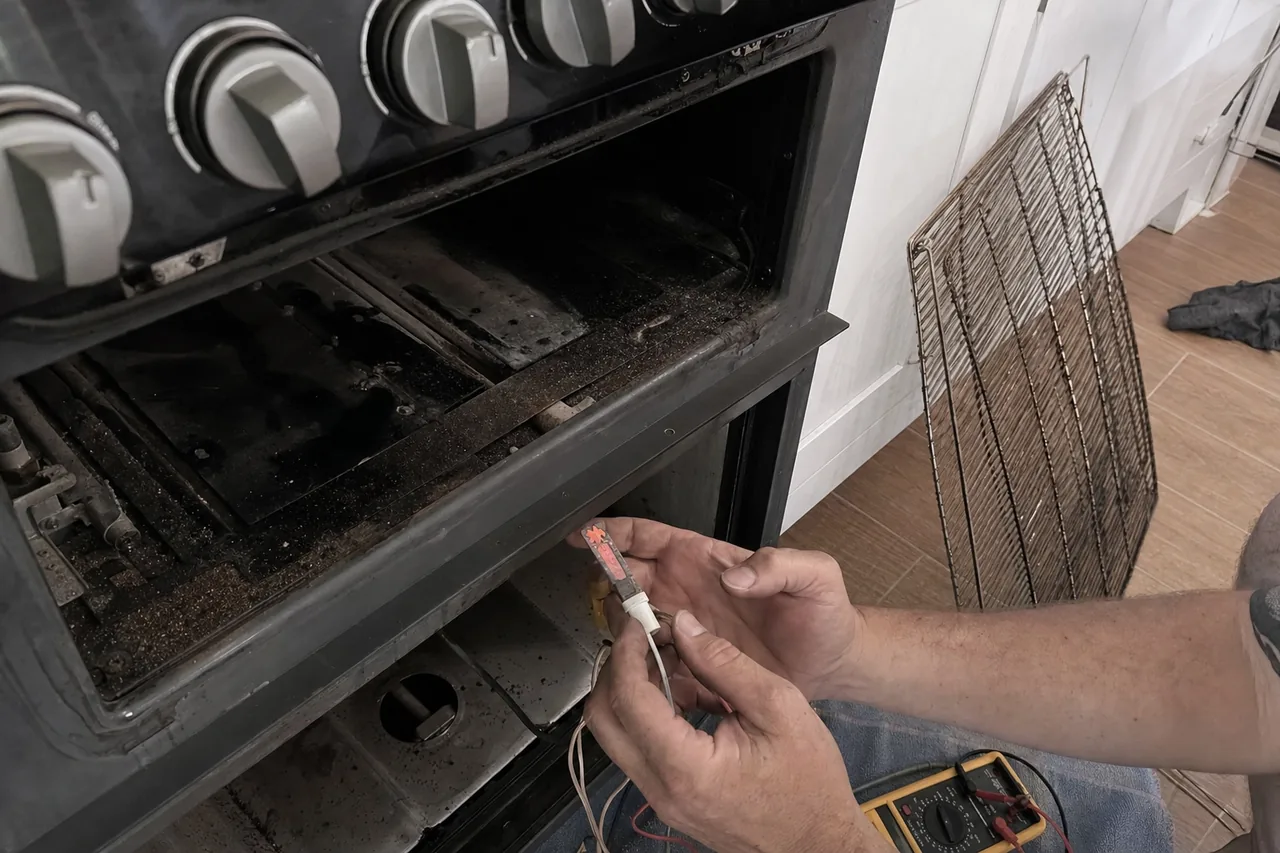
- Oven is completely dead, no display, no heat
- Bake works but broil does not, or the reverse
- Oven stopped working after a self-clean cycle
- Door locked itself and will not release
- Convection fan runs but the oven still cooks unevenly
- Touch controls respond to some presses and not others
- Door glass has shifted or the door hangs crooked
- Cooling fan runs on long after the oven is off
A built-in wall oven is a sealed box that lives inside a cabinet, and that changes the economics of every repair. The part is rarely the difficult item. Getting the machine out of its opening without damaging the surround, working on it, and setting it back in square is where the labour goes. Because of that, the survey on a wall oven is deliberately slower at the start: it is worth ten minutes of measurement to avoid pulling a unit that did not need to come out.
Dead, or half dead
An oven with no display and no heat is a supply question before it is an appliance question. Electric wall ovens are usually fed by a two-pole breaker, and losing one leg of that supply produces a very particular symptom set — some functions alive, others not, or a display that lights while nothing heats. A breaker that looks closed can still have opened one pole. That is a two-minute check at the panel and it comes first.
If both legs are present, the split between bake and broil is the next fork. Two elements, two circuits through the control. Bake without broil, or broil without bake, points at one element or one relay rather than at the board as a whole. An element that has failed open often shows it: a blister, a split, or a bright scorch where it burned through. An element that has failed closed to the cabinet will trip the breaker instead, immediately and every time.
After a self-clean cycle
Self-clean is the hardest thing an oven ever does to itself. The cycle runs the cavity far above any cooking temperature for hours, with the door locked, and everything in the appliance sits in that heat: the door latch motor, the temperature sensor, the thermal cut-out, the wiring at the back of the cavity, and the control board behind the fascia.
So when an oven works perfectly until a clean cycle and is dead afterwards, that is not coincidence and it is not usually the board first. Check the thermal cut-out. It is a one-shot safety device that opens on overtemperature and does not reset, and it is there precisely so that the expensive parts survive. Then check the latch: a door that locked and will not release has either lost the latch motor or is being told by a sensor that the cavity is still too hot to open.
If you have an oven due for a clean cycle and a dinner that matters, run the cycle a week early, not the night before. That is not a warranty, it is just the order of operations that costs you least.
Even heat, and the convection fan
Uneven cooking with a convection fan that visibly runs is a heat problem, not an air problem. The fan moves whatever heat exists; if the element behind it is weak or cycling short, the fan distributes an inadequate amount of heat evenly and the result reads as uneven browning. Confirm the cavity actually reaches and holds setpoint before anyone touches the fan.
A door that no longer seals produces the same complaint from the other direction. Heat leaking along the top edge or the hinge side forces the control to fire longer, and food nearest the leak browns differently from the rest. Doors and gaskets are checked before sensors on every oven we survey.
Controls and the cooling fan
Touch controls that respond to some presses and not others are usually the membrane or its ribbon connection rather than the processor behind it. Heat and years make that surface stiff.
A cooling fan that runs on after the oven is off is generally correct behaviour — it is clearing residual heat from the electronics — but a fan that never stops, or that runs when the oven has been cold for a day, points at the control or the thermostat that governs it.
Doubles and stacked pairs
On a double oven, note which cavity fails and whether the other one behaves normally. Two cavities that share a fascia do not share elements, sensors or latches, and a fault confined to one cavity rules out the shared parts before we open anything.
What does built-in wall oven repair cost?
The visit is a flat $80, credited toward the repair when you approve the work. What the repair runs on built-in wall oven repair is below, parts and labour together, before the written estimate narrows it to one figure.
| Work | Parts and labour |
|---|---|
| Diagnostic visit | $80 flat, credited |
| Oven thermostat or heating element | $190–$610 |
| Control board or touch panel | $380–$940 |
It is a band and not a price because one symptom is usually several repairs, and they do not cost the same. The survey is what picks which one it is. The whole book, and what the fee buys.
Asked before a wall oven call
- What does built-in wall oven repair cost in Clay County?
- The visit is a flat $80, credited toward the repair when you approve the work. Control board or touch panel work runs $380–$940, parts and labour together. An itemised estimate reaches you before a part is ordered, and turning it down costs the diagnostic and nothing beyond it.
- How long is built-in wall oven repair guaranteed?
- 90 days on the labour, 365 days on parts we supply. Genuine OEM parts only. We do not fit aftermarket substitutes into a professional range. An aftermarket igniter or sensor is the commonest reason a professional appliance comes back a second time, so none of them ride on the van.
- What should I have ready when I call?
- The model and serial off the rating plate, the symptom in the words you would use, and what changed just before it started. Parts on this equipment are revised mid-production, so the serial decides which one is correct more often than the model does.
Places on the peninsula where this equipment fails in a way worth writing down separately.
- Fleming Island: what actually fails hereA peninsula of kitchens that got their professional equipment when the houses were built. What ends its service life is ignition, sensing, control and wear.
- Eagle Harbor: island rangetops, remote blowersA golf community whose kitchens mostly went in with the houses. That single fact decides which parts we carry to an Eagle Harbor address.
- Hibernia Plantation: retrofit kitchensThe oldest-settled corner of the island. Older houses mean retrofit kitchens, and a retrofit kitchen fails at the install before it fails at the appliance.
Surveys that work through one of these faults step by step.
- When a Viking oven drifts off setpointFour checks in order, cheapest and most likely first. Most ovens that will not hold temperature are not asking for a control board.
- Heavy doors, hinges and springsA door is a heat seal that happens to swing. When it stops closing square, the oven starts behaving like a sensor fault — and replacing the sensor changes nothing.
- Storm season and control boardsBoards do fail here, and they mostly fail on a date rather than from age. That is a useful thing to know, because it changes the order of the whole survey.
- When the igniter glows but nothing lightsThe most convincing-looking part in a gas oven is often the failed one. Brightness proves nothing; only the current it draws opens the gas valve.
- Reading the rating plateTwo numbers off a metal tag decide whether the part is on the van or on order. Here is where the tag is on each kind of appliance, and what else to read off it.
What owners said after this work
4.5 out of 5, across 70 published owner notes. Read all of them.
Everything was coming out of the oven pale on top. He put a meter on the broil element, showed me it drawing well under what it should, and swapped it. The top browns the way it used to again.
Rowan V.
The upper cavity ran cold while the lower one was fine, which I took for two faults. He traced it to a failed relay on the board they share plus a broken element lead, and explained why one board serves both.
Vivienne A.
The display had gone dim and the touch panel only answered in patches. Rather than quote the whole control he checked the ribbon connector first, found it corroded, and the panel came back to life. Honest about it too.
Dashiell G.
Fleming Island, Clay County. Have the model number off the rating plate ready — it decides which parts ride out on the van. What a visit costs.