Viking kitchen appliances · rangetop
Rangetop and cooktop repair
A rangetop has no oven to hide behind. Ignition, gas delivery and flame quality account for very nearly every call we take on one.
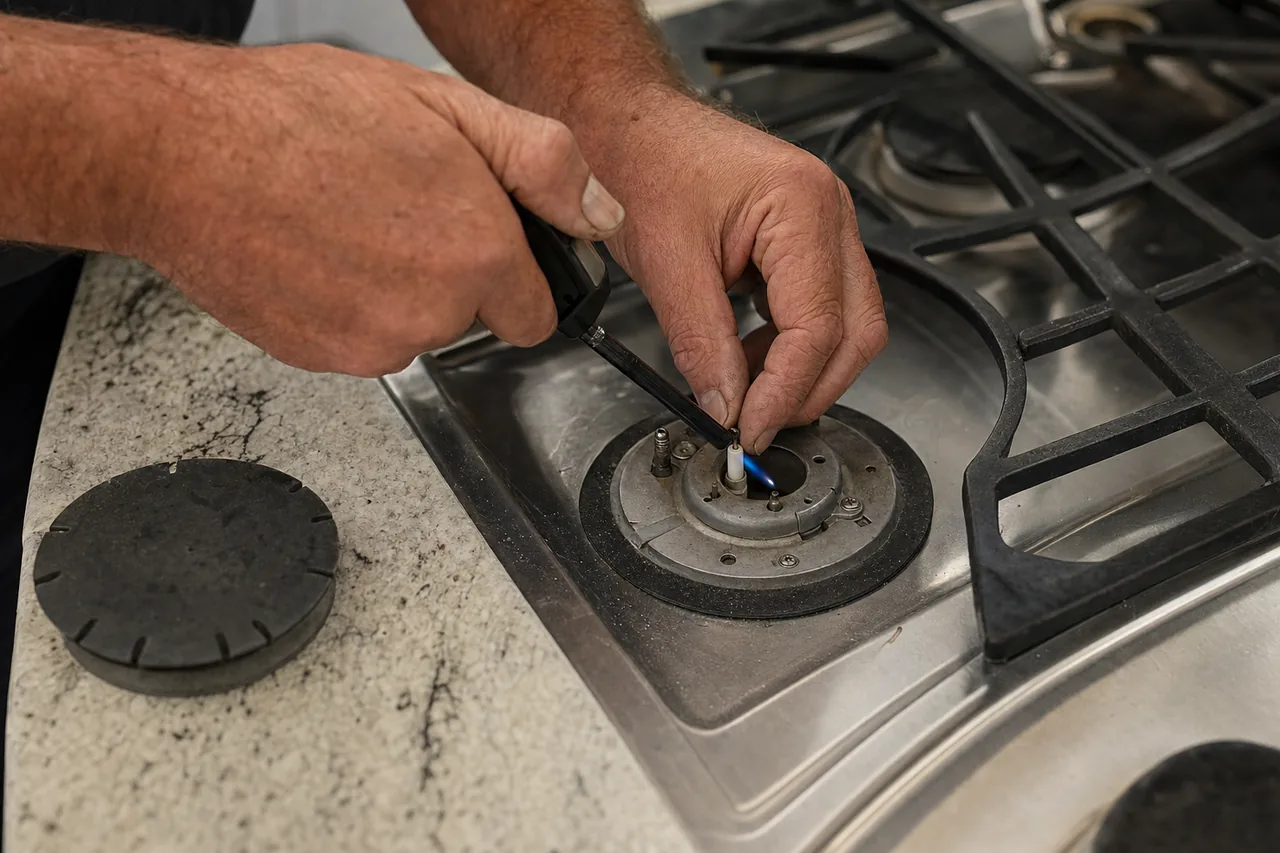
- One burner clicks and clicks but never catches
- Every burner clicks at once, even with all knobs off
- Igniter clicking but no spark reaches the burner
- Flame lifts off the ports or burns yellow at the tips
- Simmer setting will not hold a low flame
- Knob turns stiff, or will not push in to light
- Burner lights, then drops out a few seconds later
- Griddle or grill section runs hot on one end
- Burner flame is uneven around the ring
A rangetop is the simplest thing we service and the one most often misdiagnosed, because everything it does happens in the open where you can watch it. Work through it in order and the fault usually names itself before a meter comes out of the bag.
Start with what the flame looks like
A correctly set burner on natural gas burns blue, with a defined inner cone sitting just above the port. Yellow tips mean the mixture is short of air: debris in the ports, a cap seated a fraction off its ring, or an orifice sized for the wrong fuel. A flame that lifts clear of the port and roars is the opposite problem — too much gas pressure or too much primary air for that orifice.
That last case is worth naming plainly, because it is the one people inherit rather than cause. Rangetops ship set for one fuel and are converted to the other with a kit: different orifices, and in most cases a different regulator setting and a different low-flame adjustment on each valve. Both fuels are common in this part of Clay County. If the appliance came with the house, nobody in the house necessarily knows which way it was set, and a half-finished conversion produces exactly the symptoms above. Tell us which fuel you run when you book and the right kit rides out on the van.
The clicking
Clicking is spark, and spark is cheap to observe. If one burner clicks and does not light, spark is arriving and gas is not. Lift the cap and check the seating first; a cap set down a millimetre proud after cleaning spreads the flame sideways instead of up, and the burner will not carry a flame around the ring. Then look at the ports themselves — a boil-over that dried in place blocks enough of the ring to stop the flame travelling.
If every burner clicks at once, and keeps clicking with the knobs off, the fault is upstream of any burner. That is the spark module or a switch that has not fully released, and it is almost always liquid: a spill runs down behind a knob, finds the switch, and holds the circuit closed. The module fires because it is being told to.
If nothing clicks at all, look at the electrode before the module. The white ceramic insulator at each burner cracks, and a cracked electrode arcs to the nearest metal instead of across its gap. You can often see the scorch mark.
Lights, then goes out
A burner that catches and then dies within a few seconds of releasing the knob is a flame-sensing fault, not a spark fault. The safety valve holds open only while it is being told a flame exists. Lose that signal and the valve shuts, which is the system working correctly on bad information. It is a small part and a short job, and no amount of work on the spark side will change it.
Simmer, and stiff knobs
The low end of the range is where a professional rangetop earns its money and where wear shows first. A burner that will hold a rolling boil but drops out at its lowest setting is usually the valve’s low-flame adjustment drifting rather than the burner itself. That is a screw, not a part.
A knob that has gone stiff, or that will not push in far enough to reach the spark position, is the valve grease drying out. Valves can be pulled, cleaned and regreased. Forcing a stiff knob is how a valve stem gets snapped off, and a snapped stem turns a cheap job into a manifold job.
Griddle and grill sections
Where a rangetop carries a griddle plate or a grill, treat that section as its own appliance. A griddle that runs hot at one end is a thermostat or sensor problem within that section and has nothing to do with the burners beside it. Confirm the plate is sitting flat first — a warped plate reads as a control fault and is not one.
Before you call
Note the fuel, note whether the fault is one burner or all of them, and note whether it started after a spill or a cleaning. Those three answers narrow the survey to one branch before we arrive.
What does rangetop and cooktop repair cost?
The visit is a flat $80, credited toward the repair when you approve the work. What the repair runs on rangetop and cooktop repair is below, parts and labour together, before the written estimate narrows it to one figure.
| Work | Parts and labour |
|---|---|
| Diagnostic visit | $80 flat, credited |
| Igniter or burner assembly | $210–$520 |
| Control board or touch panel | $380–$940 |
It is a band and not a price because one symptom is usually several repairs, and they do not cost the same. The survey is what picks which one it is. The whole book, and what the fee buys.
Asked before a rangetop call
- What does rangetop and cooktop repair cost in Clay County?
- The visit is a flat $80, credited toward the repair when you approve the work. Control board or touch panel work runs $380–$940, parts and labour together. An itemised estimate reaches you before a part is ordered, and turning it down costs the diagnostic and nothing beyond it.
- How long is rangetop and cooktop repair guaranteed?
- 90 days on the labour, 365 days on parts we supply. Genuine OEM parts only. We do not fit aftermarket substitutes into a professional range. An aftermarket igniter or sensor is the commonest reason a professional appliance comes back a second time, so none of them ride on the van.
- What should I have ready when I call?
- The model and serial off the rating plate, the symptom in the words you would use, and what changed just before it started. Parts on this equipment are revised mid-production, so the serial decides which one is correct more often than the model does.
Places on the peninsula where this equipment fails in a way worth writing down separately.
- Fleming Island: what actually fails hereA peninsula of kitchens that got their professional equipment when the houses were built. What ends its service life is ignition, sensing, control and wear.
- Eagle Harbor: island rangetops, remote blowersA golf community whose kitchens mostly went in with the houses. That single fact decides which parts we carry to an Eagle Harbor address.
- Doctors Lake: undercounter refrigerationBoth shores of the lake, from Doctors Inlet south. The recurring fault here is not a fault at all — it is refrigeration installed in air it was never rated for.
Surveys that work through one of these faults step by step.
- When the igniter glows but nothing lightsThe most convincing-looking part in a gas oven is often the failed one. Brightness proves nothing; only the current it draws opens the gas valve.
- Continuous clicking after a spillContinuous spark on every burner is upstream of any single burner. Dry it out properly before anyone buys a spark module, because most of these dry out.
What owners said after this work
4.5 out of 5, across 70 published owner notes. Read all of them.
He got there in the end and the flame is even again. Getting there meant a wrong part on the first order and a long wait for the right one. The bench work was careful; the parts pipeline was anything but.
Oksana R.
Two of the six burners would not spark at all. He found a cracked electrode and a wire that had been chafing against the frame since installation, replaced both, then dressed the harness clear of the edge.
Priya N.
The griddle plate had warped and everything slid into one corner. Instead of selling me a plate straight off he checked the burner under it, found a frame leg sitting proud and shimmed it. That took most of the tilt out.
Trina S.
Fleming Island, Clay County. Have the model number off the rating plate ready — it decides which parts ride out on the van. What a visit costs.