Fault survey · Viking kitchen appliances
Viking refrigerator leaking water from the bottom
Four sources account for nearly every puddle under a Viking refrigerator. The water's position and timing tell you which one, and most of the checks need no tools.
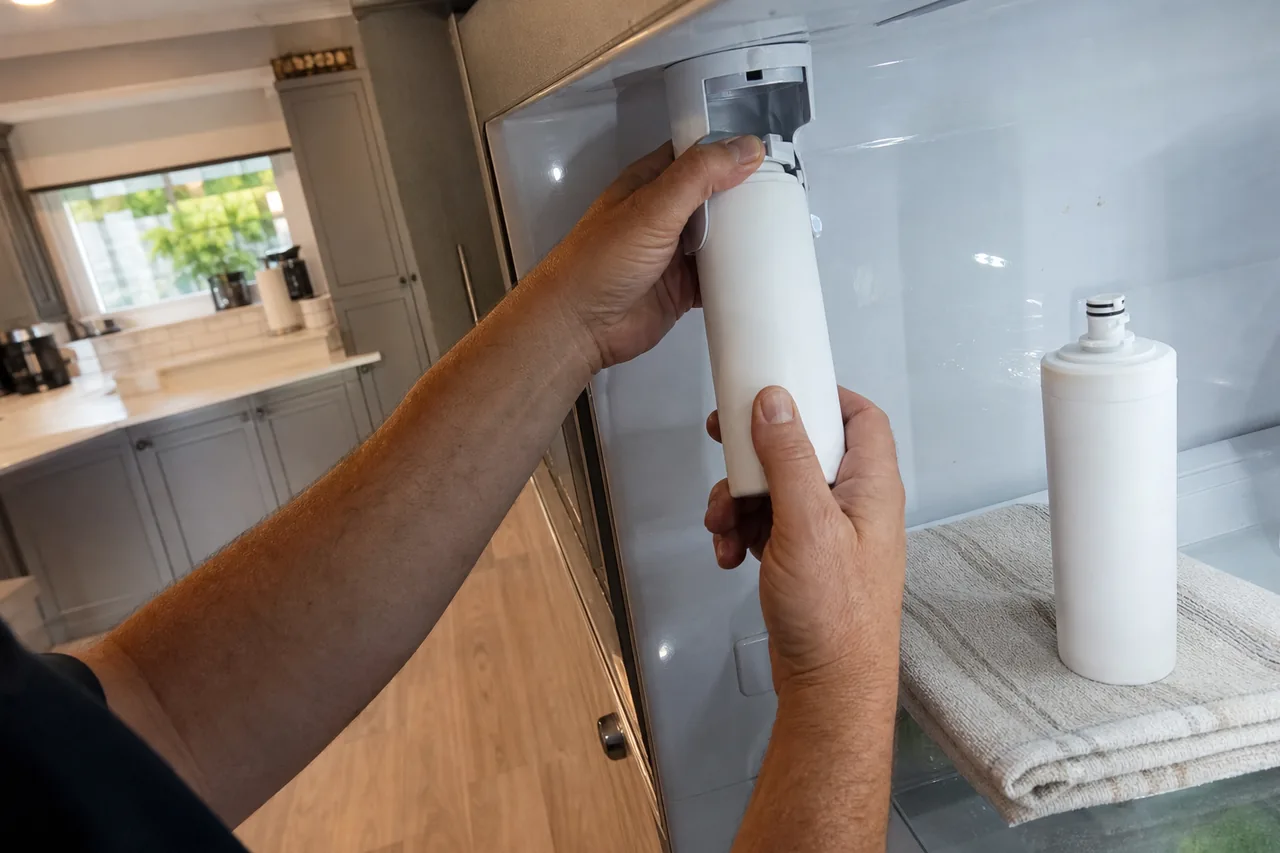
A Viking refrigerator leaking water from the bottom is nearly always losing it from one of four places: a defrost drain that has iced over or clogged, a drain pan that has cracked or slipped, the water line feeding the filter and ice maker, or condensation from a door that no longer seals. Where the puddle sits, how cold it is and when it appears will usually point to the right one within minutes, without moving the unit.
Read the puddle before you mop it
The water’s position and timing narrow the search more than anything else.
- Centred under the front grille, refilling slowly all day: defrost meltwater that never reached the pan, or a pan that has stopped holding it.
- Toward the back or one side, clear and cold: the supply line, its fitting, the inlet valve or the ice maker fill.
- Under the crisper drawers first, then on the floor: a blocked defrost drain backing up inside the cabinet.
- Streaks down the door face on humid afternoons: room air slipping past a gasket and condensing.
Cloudy or stale-smelling water has usually been sitting in a drain or pan; clean, icy water is more often fresh supply water.
The defrost drain and the drain pan
Frost-free refrigeration melts the frost off its evaporator coil on a timed cycle. The meltwater runs down a trough, through a narrow tube and into a shallow pan near the compressor, where warm air evaporates it. When crumbs or a plug of ice block the tube, the water spills into the compartment and then out under the door. A cracked or displaced pan sends it straight to the floor.
Lift out the crisper drawers and look for standing water or a sheet of ice across the back wall. Ice that keeps returning after you clear it suggests the defrost heater, its thermostat or the control is not finishing the cycle. On a built-in the pan sits behind the front grille; shine a flashlight in, but leave the heavy, anchored unit in its opening.
A defrost system repair typically lands in the $250–$610 range; the $80 diagnostic pins down which part has failed, and the firm quote follows from that.
Supply line, inlet valve and filter
Close the shutoff valve for the refrigerator’s water line, usually under the sink or in a neighbouring cabinet, and dry the floor. If the puddle stops returning, the leak is on the water side. Viking’s integrated FDREIC all-refrigerators are meant to run on a 1/4-inch copper line at 20 to 120 psi; pressure well beyond that strains the fittings and the inlet valve.
The filter is a frequent culprit right after a change, because a cartridge that is not fully seated weeps into its housing. On integrated VRI and VFI columns, the RWFDISP cartridge sits low on the right behind the door and releases with a quarter turn counterclockwise; press the lit FILTER button once the new one is in. The RVFFR336 French-door model takes RWFRVFFR, due every 6 months, and holding Alarm Off for 3 seconds clears its reminder. Older built-ins under manual F20413, VCSB423 and VCBB363 among them, need the cartridge swapped at nine months or 750 gallons, whichever comes sooner, and the dispenser run for three minutes afterwards.
If there is an ice maker, trace its fill tube too. Viking puts a leaking water line among the first things to rule out when a 5 Series built-in stops producing ice.
Door gaskets and humid air
Clay County summers are humid, and whenever a door fails to close tight, that moist air meets cold surfaces and turns to water. It runs down the inner door and onto the floor, often only on busy afternoons. Shut a sheet of paper in the door at the top, bottom and both sides, then tug it; you want to feel resistance. Anywhere it slides out freely, the seal has a gap.
Viking’s schedule for built-in gaskets is a wash every three months, either with mild detergent or with 4 tablespoons of baking soda stirred into a quart of warm water. Afterwards, rub a very thin layer of petroleum jelly into the rubber so it stays soft. A gasket that is torn or has taken a permanent fold needs replacing, not cleaning.
When the leak needs a technician
If water has reached the outlet or wiring behind the unit, switch off the breaker first. Beyond that, call when ice keeps rebuilding on the back wall after you clear the drain, when the floor stays wet with the water supply closed, or when a built-in has to come out of its cabinetry to reach the pan or valve. Under a built-in, a slow leak can soak the cabinet base and subfloor for weeks before it shows.
Keelson is an independent repair service working on Viking refrigeration around Fleming Island, Doctors Lake and Eagle Harbor. Before calling, note the model and serial number from the rating plate; the pricing page explains the diagnostic fee, and built-in refrigeration repair covers the wider work.
What does this one cost to put right?
The visit is a flat $80, credited toward the repair when you approve the work. What the repair runs on viking refrigerator leaking water from the bottom is below, parts and labour together, before the written estimate narrows it to one figure.
| Work | Parts and labour |
|---|---|
| Diagnostic visit | $80 flat, credited |
| Control board or touch panel | $380–$940 |
| Refrigeration fan or defrost system | $250–$610 |
| Compressor or sealed-system repair | $960–$2,580 |
It is a band and not a price because one symptom is usually several repairs, and they do not cost the same. The survey is what picks which one it is. The whole book, and what the fee buys.
Asked after reading this
- What does this repair cost?
- Compressor or sealed-system repair work runs $960–$2,580, parts and labour together, on top of the flat $80 diagnostic that is credited toward the repair when you approve the work. The survey is what turns a band into the one figure written on your estimate.
- Is viking refrigerator leaking water from the bottom worth repairing at that figure?
- Set it against $4,800–$17,500 for a comparable Viking appliance, before delivery, installation or cabinetry. Professional equipment is built to be repaired, so the answer is usually yes — and where it is not, we tell you before ordering anything.
- Do you work on any make other than Viking?
- No. One manufacturer is what puts the correct igniter, spark module and oven sensor on the van before the first visit rather than after it. A shop claiming every brand is carrying the parts for none of them.
The service pages this survey belongs to.
- Built-in refrigeration repairColumns, French-door built-ins, undercounter drawers and wine storage. Airflow, defrost and door seal explain most of it before the sealed system does.
Places where this fault shows up often enough to be worth the note.
- Fleming Island: what actually fails hereA peninsula of kitchens that got their professional equipment when the houses were built. What ends its service life is ignition, sensing, control and wear.
- Doctors Lake: undercounter refrigerationBoth shores of the lake, from Doctors Inlet south. The recurring fault here is not a fault at all — it is refrigeration installed in air it was never rated for.
- Eagle Harbor: island rangetops, remote blowersA golf community whose kitchens mostly went in with the houses. That single fact decides which parts we carry to an Eagle Harbor address.
Reading a survey and recognising your own appliance in it is a good reason to call. What a visit costs.